Keep going with new words
Use narration, pinyin and the dictionary to build vocabulary through stories.
 Log in
Chinese stories to share at home
You don’t need to know every character. Listen, look at the pictures, and talk with your child.
A few minutes of shared reading can become a treasured memory.

Share a story, together
Listen, look and talk. Enjoy each moment of reading together.

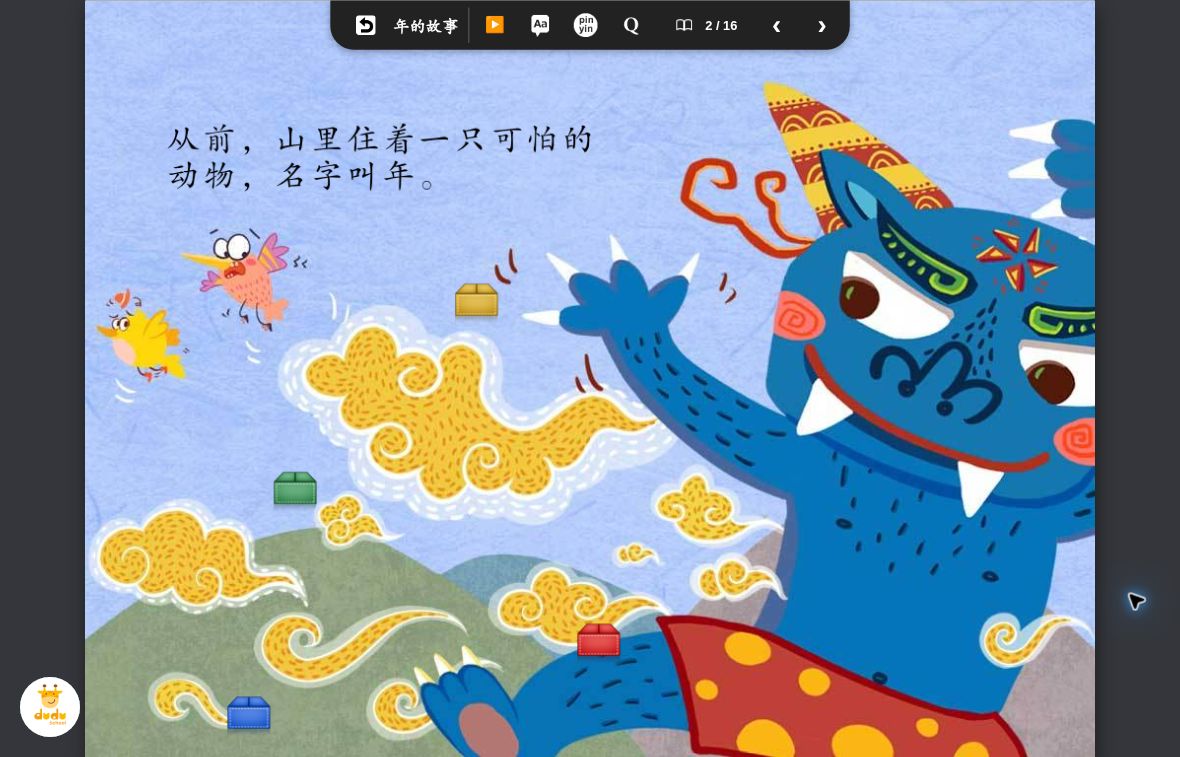
Play a short passage and follow the story’s voices together.
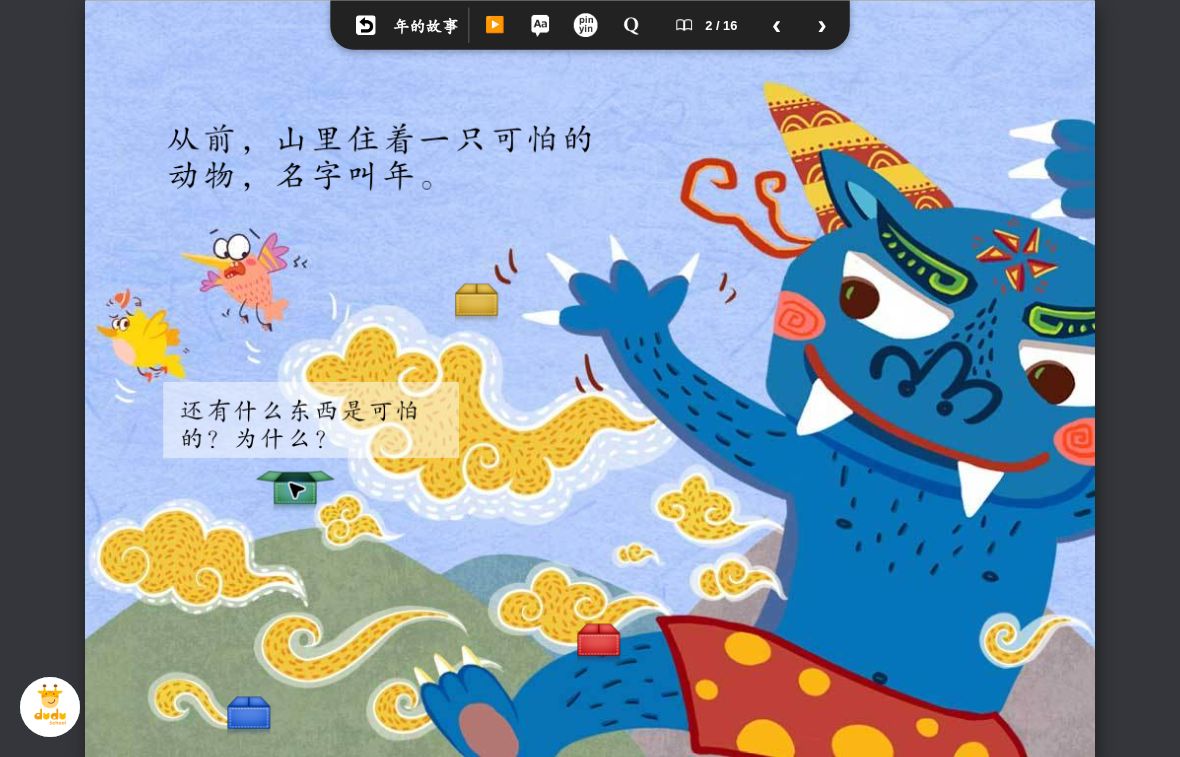
Pause to notice the details. Ask: “What do you see?”
Ask what might happen next. Let your child share an idea in a familiar language.
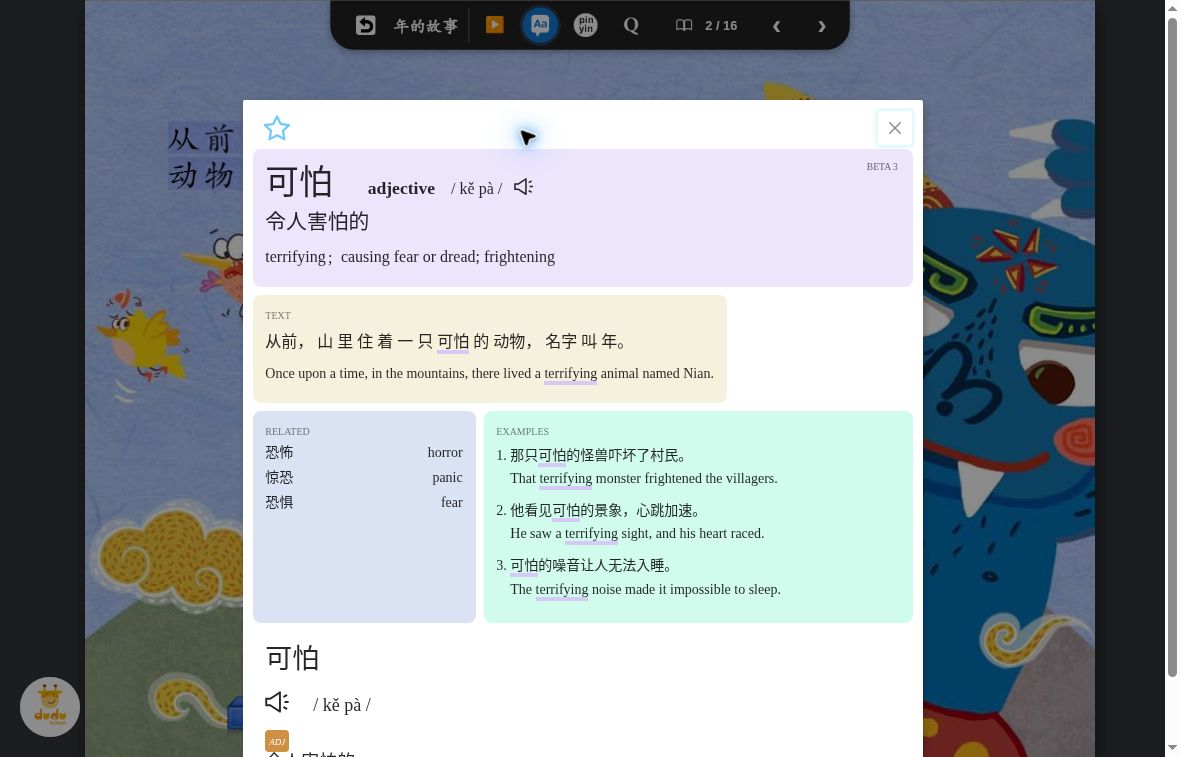
Use narration, pinyin and the dictionary to build vocabulary through stories.
Begin with books matched to reading ability, so your child can approach the next story with confidence.
Follow your child’s interests and use reading history to notice the small steps along the way.
Good moments begin with good stories
Enjoy the imagination of tales, the atmosphere of poetry, and the beauty of words and pictures.
Culture & traditionsStory: 司秋雪; Illustrations: 廉雪芬; Narration: 糖音.
L2.2 · First stories Poetry & art
Poem: Liu Zongyuan (柳宗元); Adaptation: 王润桃; Illustrations: Wang Li (王丽); Narration: 司秋雪.
L9.8 · A deeper challenge Tales & fables
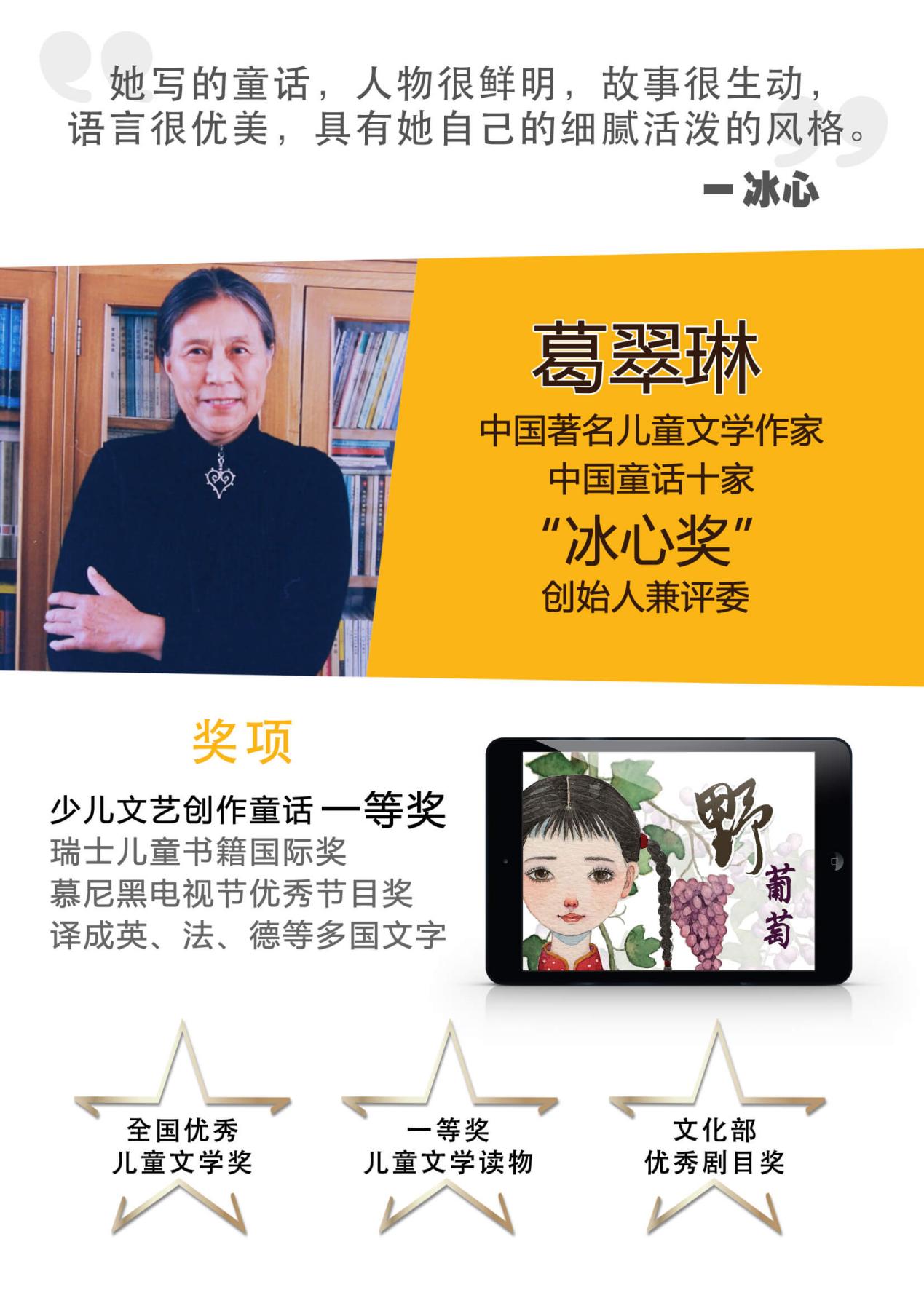
Story and narration: Ge Cuilin (葛翠琳); Illustrations: Xu Yi (徐怿).
L6.8 · Reading independentlyWords, culture and art, in every shared story.
Authors & stories
Dudu brings together work by more than 100 authors. Meet some of our award-winning writers and explore a wealth of literary lives, honours and stories.
Reading support
Use a little help when you need it. Keep your attention on the story and your child.
Listen first, without having to read every character aloud.
Check a pronunciation, then return to the story.
Explore the meaning and sound of an unfamiliar word.
Open a question and invite a child’s own ideas.
Begin with the right story
Match the reading level, then let your child choose a story they love.
A placement test matches a suitable reading level for an enjoyable start.
Explore tales, science fiction, fables and history. Follow the topics your child enjoys.
Make a little space for reading in everyday life.
Levels guide book choices; every reader grows at their own pace.
The Story of NianL2.2 The Fox and the Sour GrapesL3.8
 Learning to Keep a Pet on Planet WeiziL4.5Little Mouse, Big MouseL6.8
 Watt and the Steam EngineL7.8River SnowL9.8
Grow together through the stories you share.
Choose by reading ability, with school stage as a rough guide. The placement test on first login recommends a starting point for your child.
A starting point for early readers: listen, notice familiar words and enjoy the pictures.
For readers ready for more vocabulary and fuller stories, often in lower primary.
For readers exploring more complex stories, often in upper primary.
For confident readers exploring advanced vocabulary and ideas, including secondary readers.
A label such as L2.2 describes the book’s reading level, not a child’s age. Children in the same school year may need different books.
Start Your 2-Week Free Trial
He is also more confident as he attempts to read new books along with the audio reading.
My son is very weak in Mandarin and lost interest in reading Mandarin books over time due to his inability to sound out the words independently. I found out about Dudu through a friend's Instagram post and decided to give it a try. The programme is wonderful as it recommends books which are suitable for my son's reading ability. The colourful illustrations with occasional animations, coupled with the games and achievements at the end of each book, made learning fun and engaging for my boy. He no longer fears to explore new books on his own as he can listen to the audio reading accompanying each ebook, which guided his learning. There is a great improvement in his pronunciation as he read the stories aloud. He is also more confident as he attempts to read new books along with the audio reading. Dudu has plenty of interesting ebooks to choose from and I no longer need to worry about where and how to find stories that are suitable for him to read. Without having to buy or borrow physical books for him, I no longer worry about missing library days due to bad weather or having my house cluttered with insufficient storage for all his books.

…I observed the boys were doing more regular reading…
Both Gordon and Brandon do not have general interest in reading, especially Mandarin books, since young. My husband and I would try to borrow books from the library occasionally but the boys hardly completed the books as the content were too heavy for them to comprehend and enjoy on their own if we were unable to set aside time to read with them. A close friend had recommended Dudu to us during last school holidays and we decided to give it a try for both boys. Despite their relative short period of usage (less than 3 months), I observed the boys were doing more regular reading as they were able to make good progress on the interactive ebooks on their own. The key highlight of Dudu is the Placement Test which will assess the children’s Mandarin reading level upon first login and then recommend appropriate books based on their language ability. The audio narration and dictionary are useful features which give them the confidence to approach any challenging words in the ebooks and building up their vocabulary bank. With the positive reading experience and progress made by my 2 boys, I’ll strongly recommend Dudu to any parent who is exploring for good and interesting online reading programme for their children.

Grace has been using Dudu for 2 months and she can navigate through Dudu easily and reads around 10 books per week...
Grace loves to read but I did not know how to find Mandarin books that are suitable for her reading age. A friend recommended that we give Dudu a try and we have been loving it since! She has been using Dudu for 2 months and she can navigate through Dudu easily and reads around 10 books per week. She is able to recognise more words now than before she started using the programme. Her confidence level in reading has also increased as a result. Dudu has made learning the language more fun and engaging. The bright colours and cute graphics made the ebooks very attractive too!
These are individual experiences; every child’s reading journey differs.
Care behind every story
Expertise in language technology and Chinese education.

Deputy Head, Asian Languages and Cultures, National Institute of Education, Nanyang Technological University, Singapore
A/P Tan Chee Lay is an Associate Professor in Chinese and the Executive Director (Research & Development) of the Singapore Centre for Chinese Language (SCCL) at Nanyang Technological University (NTU). He is also the Acting Deputy Head of Asian Languages & Cultures Academic Group at National Institute of Education (NIE). He has a PhD in Oriental Studies from Cambridge University. An award-winning writer, he has published over 20 creative writing and scholarly books.

Strategic consultant in AI and education to edtech firms and universities in the US, Hong Kong and mainland China.
Dr H.O. Angus Chan holds an EdD from Durham University. He has led major educational publishing houses and e-learning enterprises in Hong Kong for over two decades. The author of more than 20 books, he writes on AI strategy, AI in education, self-directed learning, higher-order thinking, STEM education, youth counselling and parental education. His recent work explores AI-humanistic education and the role of augmented intelligence in work and learning.

Provost's Chair Professor of Computer Science at the National University of Singapore.
Professor Ng Hwee Tou is Provost's Chair Professor of Computer Science at the National University of Singapore (NUS), a Senior Faculty Member at the NUS Graduate School for Integrative Sciences and Engineering, and Vice Dean (Research) at the NUS School of Computing. He received a PhD in Computer Science from the University of Texas at Austin, USA. Apart from being an award winner of the Best Paper Award where he published papers in premier journals and conferences, he is also a book review editor of Computational Linguistics, an action editor of the Transactions of the Association for Computational Linguistics (TACL), an editorial board member of Natural Language Engineering, and a steering committee member of ACL SIGNLL.

Strategic IT Management Practice at the Institute of Systems Science, NUS.
Dr Leong Mun-Kew is Chief, Strategic IT Management Practice at the Institute of Systems Science at the National University of Singapore. His portfolio covers a broad spectrum of soft and hard skills necessary for the successful management and leadership of IT in practice. Mun-Kew received his PhD from Stanford University. He has more than 25 years of R&D and commercial experience in IT. He was Chair and Editor of the ISO/JTC1/WG2/24800 JPSearch international standard, editor or past editor of the Journal of Information Retrieval, Information Processing and Management Journal, member of the advisory board for the School of IIT at Temasek Polytechnic, the IRAL and AIRS symposium series and the Steering Committee of the Singapore Bio-Imaging Consortium. He was also Adjunct Assoc. Professor at the National Institute of Education, and is a member of the forthcoming International Review Panel on IT in Education for the Ministry of Education.
2 Weeks Free
Enjoy full access to Dudu eBooks and full reading experience for 2 weeks.
2 weeks free, then
US$10/month
Flexible monthly access after your free trial.
Start 2-Week Free Trial2 weeks free, then
US$75/year
The best value for building a lasting reading habit.
Start 2-Week Free TrialFor schools
Support Mandarin teachers with leveled books, class reading data, and engaging learning games.
Your selected membership begins after the 2-week free trial unless you cancel. You can cancel anytime.
Start with the reading assessment on first login, then let your child choose an interesting book at the recommended level. Use their understanding and confidence to guide the next choice; age and school year are only rough guides.
Yes. Listen to the narration, look at the pictures, then talk in a familiar language. You do not need to know every character to notice details, share a laugh or listen to your child’s ideas.
Begin together with a book your child enjoys. Listen, look at the pictures and invite them to point or talk. They can join in with a familiar word or line when ready; reading every sentence alone is not a requirement.
If your child struggles to follow the story, try an easier book or share a short passage with narration. Use pinyin or the dictionary when needed, then return to the story. If reading feels comfortable and your child wants more, try a slightly more challenging book.
Start with a few relaxed minutes at a time that suits your family. Follow your child’s interest and energy, rather than a page target. You can stop at a favourite picture and return another day.
It is fine to enjoy a favourite again. On another reading, notice a different detail, try a familiar line together or talk about a character’s feelings. Offer another book when your child is curious, without making the favourite off limits.
No. Choose one question, share an idea or simply enjoy the pictures. Give your child time to answer in their own words; the conversation matters more than completing a checklist.
Shared-reading samples are available here for The Story of Nian, River Snow and Little Mouse, Big Mouse. They demonstrate a way to listen, look, talk and explore together. You can also download the detailed, step-by-step “Parent Child Reading Guide” PDF in the Dudu portal.
Use the reading assessment to find a starting point. Dudu recommends books for every YCT and HSK level, helping your child read comfortably and learn new vocabulary suited to the level they are studying.
Dudu recommends books for every level and every lesson of Chinese Made Easy (轻松学汉语), Chinese Made Easy for Kids (轻松学汉语·少儿版, in Simplified and Traditional Chinese), Huanle Huoban (欢乐伙伴), and Amazing Chinese (中文真棒). Your child can find suitable Dudu books aligned with the lesson taught at school.
Begin with the Nian reading sample.